A Human-Centered Approach to Fisheries Information
Understanding the needs of fishers and seafood buyers to rethink the delivery of fishery improvement project information

The Challenge
FisheryProgress has been a tried-and-true site for years, but over time technology has progressed and we heard from users that while the information on the site is important and useful, the data entry process and information display is clunky and the site can be hard to navigate. Modernizing would also give us the opportunity to add new features and, for the first time, incorporate user feedback to help improve the site.
My Work
User Research: Created master research plan; ran top tasks workshop and user story writing sessions; wrote research plans and scripts; conducted interviews; synthesized and presented results
Collaboration and Project Management: Establishing best practices and standard operating procedures for user research; research project management; facilitating internal workshops and brainstorming sessions
My Role
User Researcher
Our Team
Website Manager
2 Program Managers
Business Engagement Manager
Visual Designer
Software
Mural
Whimsical
Airtable
Calendly

Research Outcomes
Team Alignment
This research helped the entire organization understand how users utilize FisheryProgress and got our tech team to think about the new site from user's perspective. It gave the team an opportunity to brainstorm and share their knowledge in a collaborative way that built a collective understanding of priorities moving forward.
User Insights
The research provided critical information about the site's three key audiences, enabling the tech team to make informed product decisions that would provide high value to users. It validated and rejected assumptions, sparked ideas, and highlighted gaps and pain points.
Best Practices
This was the first time that FisheryProgress conducted user research. An important piece of this work was establishing user research best practices for new research team, including setting the framework for generative research and evaluative methods for the existing site.
User Engagement
Users were enthusiastic about providing feedback and sharing their screens to show us how they use the site, with many asking if they could be involved in future opportunities to test and review designs. The research also served as a way to strengthen our relationships with users.
Process and Solutions
Since the FisheryProgress team hadn't previously conducted any user research, they had a lot of questions and assumptions about the website and its users. My goal with the initial round of research was to focus the team on our top research priorities that would have the biggest impact on design and user experience for the new site. I ran two discovery workshops then combined the results into a research plan.
WORKSHOP 1
Top Tasks
+
User Story Writing
WORKSHOP 2
Journey Mapping
+
Research Objectives
DOCUMENT
Master Research Plan
-
Timeline
-
Process overview
-
Audience definitions
-
Research scope & objectives
-
Recruiting process
DOCUMENT
Seafood Buyers
Research Plan
DOCUMENT
Fishery Coordinator
Research Plan
DOCUMENT
Seafood Community
Research Plan
Workshop 1 | Top Tasks + User Stories
The team had already identified and defined the three main audiences (seafood buyers, fishery improvement project coordinator, and the sustainable seafood community) for the site so I started off our research with a top tasks workshop in Mural to focus us around one question:
What are our primary audiences trying to do on the website?
With limited time for research and A LOT of questions to answer, this approach would help us get out of our organizational thinking and try to think like our users - prioritizing the tasks that users need to accomplish the most and defocusing on what matters less ("tiny tasks").


Below are the steps I led the team through:
1. For each of our three audiences, we spent five minutes brainstorming all the tasks that user group needed to complete on the website. We ended up designating two different colored sticky notes: yellow for the tasks that users do now and blue for tasks that we'd like them to do based on our grant funding or be able to do based on known user requests.


2. Next we used dot voting to anonymously vote on the top tasks for each audience and see where there was group consensus. I gave each team member three votes per audience. After everyone had voted, I led a discussion to talk through the results and grouped the results to look for further commonalities/trends.

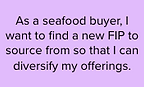
3. Last, for each group of sticky notes, we wrote user stories to capture a description of the overall task from the user perspective. Here are some examples of user stories from the workshop:


Workshop 2 | Mapping + Research Objectives
The second part of the exercise was to dig into the tasks and user stories that we had prioritized as a group, with the goal of producing a robust list of research objectives for each audience. To do this, I created a framework for each audience with swimlanes to help us work through the user stories in bite-sized pieces.
Starting with fishery improvement project (FIP) Coordinators since we knew the most about that audience, we started by mapping the user journey for each user story from the top tasks workshop. Journey mapping was an important step to ensure that we had collective understanding and agreement on the main actions that the user would take to need to complete the task. In some instances - such as for FIP leads wanting to easily receive and address feedback from their reports - we created a lean service blueprint to capture the interactions between FIP leads and our internal review team. Based on the stories and mapping, we worked to define the main problems and opportunities (our research objectives) for each user story as well as identified any additional questions or evidence.
Below is a screenshot of the completed FIP Coordinators brainstorm. To view and explore the full Mural with top tasks, mapping and objectives for each audience, click here.

Research Planning
After we wrapped up the workshops, I used the information from the brainstorming sessions, along with the development teams schedule, to create a master user research plan. The Master Plan was intended to be a high-level, evolving overview of user research for the new site that captured the big pieces of work involved and would link off to individual research plans based on audience.
Master Research Plan
-
Overall research timeline
-
Process overview
-
Audience definitions
-
Research scope & objectives
-
Recruiting process
Individual Research Plans by Audience
-
Research objectives
-
Methodology
-
Participant lists, recruiting method, and email templates
-
Task list and timeline
-
Discussion guide/script
-
Plans for synthesis and sharing out
I used the Master Plan document for four main purposes:
-
to facilitate discussions of how this work can integrate with existing development team timelines
-
to organize our thoughts as a group
-
to prioritize research themes
-
to come to agreement on next steps and timelines
A key piece of the Master Plan was also a summary of the user stories, related areas of the site, and research objectives from the Mural workshop. Looking at those items, we as a team prioritized the items that were the most time-sensitive to design/dev work timelines and needed to be included in the first round of research for that audience. I also added suggested research methods column with ways that we could investigate our research questions.

Interviews and Insights
So far we've conducted the first round of interviews for the Seafood Buyers (Sourcers) audience. We chose this audience to interview first because it's the one we know the least about and the feedback from this group had the most potential to change the features/functionality of the site. Because we also wanted to get feedback on how users are using the existing site, the interviews were a combination of one-on-one generative interviews and contextual inquiry.
I facilitated the 11 interviews while two of my colleagues, our visual designer and business engagement manager, took turns observing and taking notes.
Objectives:
-
Discover the key criteria that buyers use (or are not using) for sourcing from FIPs
-
Understand why users landing on our website aren't using the FIP Directory Search to find FIPs
-
Learn about any pain points buyers are encountering during the process when they need to find/source from a FIP and identify what improvements we can make to encourage them to engage with FIPs
Key Insights:
-
Price and volume are the key criteria buyers use to ultimately source from FIPs, but they search by species, country, and participating company to find FIPs.
-
Buyers aren't using FisheryProgress to source, but that's ok! It's a key piece of their workflow related to researching sources and verifying information.
-
Buyers consistently are using the site to validate chain of custody information which is frustrating for them to find hidden in tabs in the fishery's profile.
Objective:
-
Discover the key criteria that buyers use (or are not using) to continue sourcing from FIPs
Key Insights:
-
Buyers are primarily looking at a fishery's progress rating and if it's active/inactive
-
Buyers use the fishery's profile to see if companies are still participating in that fishery, but it's a lot of work for them to continually check this (multiple interviewees requested an alert system).
-
Buyers would like to know right away if a fishery becomes inactive AND why so they can contact their sources right away to correct the issue.
Objectives:
-
Determine if buyers have issues contacting FIPs
-
Opportunity: present customized engagement opportunities to appropriate buyers (testing dashboard concept/mockup)
Key Insights:
-
Buyers already are in touch (or know how to contact) fishery leads, FisheryProgress serves to verify the information they're given by the leads.
-
While buyers know how to contact leads, it's time-consuming to draft emails related to that fishery's progress - a couple of interviewees requested templates for encouraging progress
-
For the dashboard, buyers were excited to see one place where they could immediately access and see information on the fisheries that they follow. However, they wanted to see more trends in progress at a glance and some of the terms were confusing. More testing should be done to make it useful for this audience.
1
User Story: As a seafood sourcer, I want to find new sources that meet my company's commitment to sustainable seafood.
2
User Story: As a seafood sourcer, I want to stay up to date on my FIPs, so that I can ensure they continue to meet my sourcing policy.
3
User Story: As a seafood sourcer, I want to engage with FIPs, so that I'm able to continue sourcing from FIPs.
Report Out and Next Steps
I shared the results of the first round of research in two ways:

I created another Mural for us to use for synthesis and sharing with our organization during a Team Meeting. I broke the Mural up into sections for each question and copied applicable quotes from the interview notes. The quotes were color codded (see the key on the left) to make it easy to spot and see trends in positive feedback, pain points, and ideas. For each question, I worked with our interview team to summarize our findings then we presented to the team, each taking a different question to lead for the discussion.

I also took all the quotes and added them to an Airtable document with tags for topics/parts of the site and the interview details. In this format, I'm able to share specific views with our designer and development team. It will also serve as a master research repository for all of the audiences we're interviewing so we can easily sort through all the data without needing to open multiple Murals.